



- Medical Billing & Coding
2026 Radiation Oncology Coding Changes: Implementation Guide
The most consequential radiation oncology code update in more than a decade is not just a coding-team problem. The January 1, 2026 treatment-delivery and image-guidance changes affect how a practice identifies a service, documents its complexity, secures authorization, generates charges, configures claims, interprets contracts, and monitors reimbursement. Organizations that treat the transition as a codebook swap risk leaving old logic active in one of those connected steps.
The governing change is conceptual: the revised external beam treatment-delivery hierarchy focuses on delivery complexity rather than simply distinguishing 3D treatment from IMRT. The revised codes also include the technical portion of image guidance when performed. ASTRO has called the shift substantial, and its early-2026 payer updates show that operational and reimbursement reconciliation remain important after go-live.
What was deleted, and what was revised?🔗
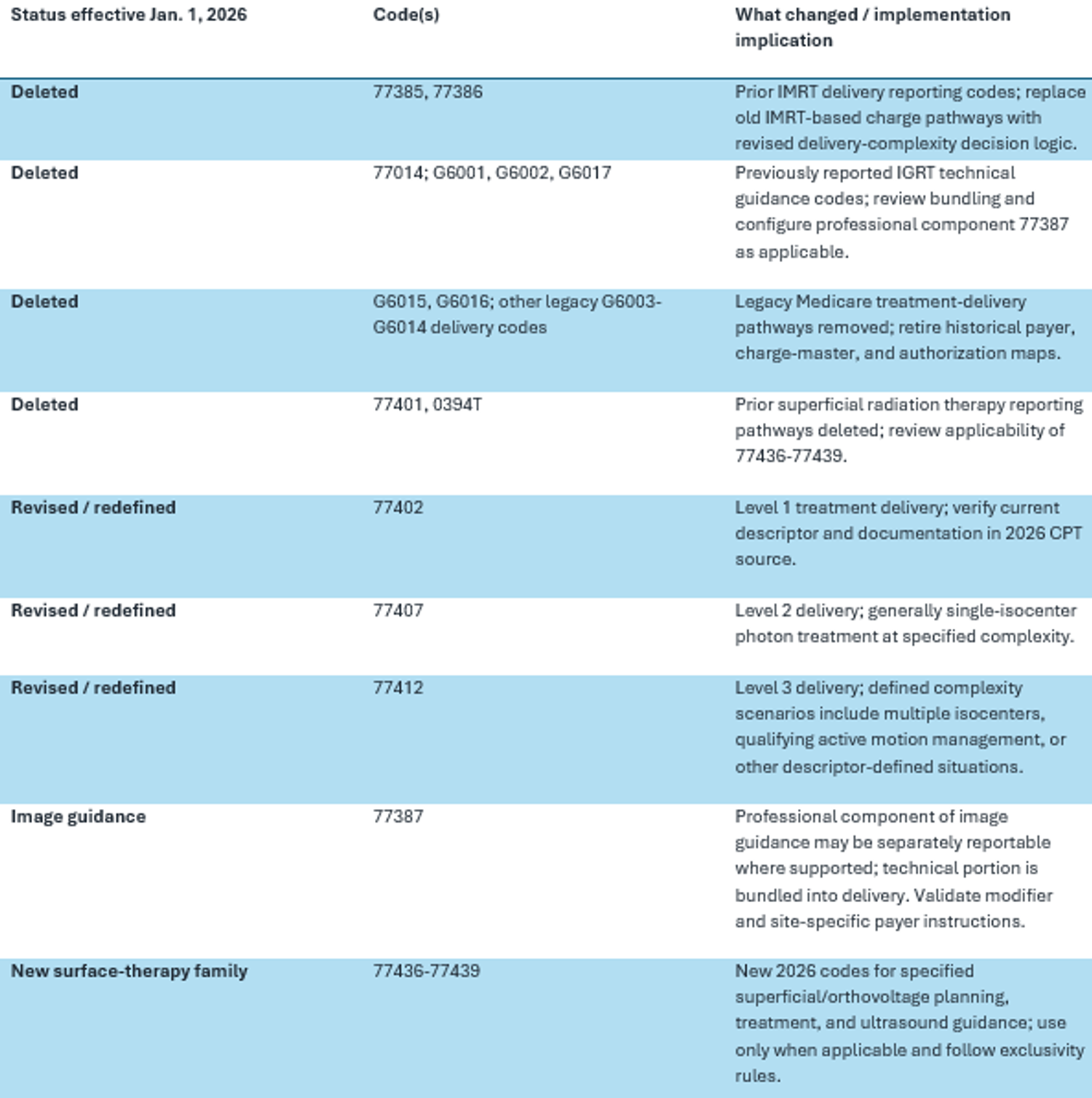
The code numbers 77402, 77407, and 77412 already existed, but their descriptors and selection logic were revised for 2026. They should be described as redefined codes—not wholly new code numbers. The table below separates deleted codes from the revised delivery framework and newly introduced surface-therapy code family.
Start with treatment logic, not a find-and-replace exercise🔗
A legacy rule that says “IMRT goes to 77385/77386” cannot simply be redirected to one new destination. For 2026, the documentation supporting treatment delivery must capture the characteristics that determine the appropriate level. For higher-complexity delivery, the description of multiple isocenters, active motion management, or other qualifying criteria matters. Coding staff need a clinically meaningful decision tree that translates treatment information into the revised framework without relying solely on the technique label.
Make that decision tree a joint product of clinical leadership, physics/dosimetry, ROCC-certified coding specialists, billing, and compliance. Review representative treatment scenarios from actual operations, including single-isocenter IMRT, multiple-isocenter photon delivery, active motion management, conventional treatments, and superficial therapy if offered. Establish what each group documents and what the coder must verify before release.
Build an implementation workstream that follows the claim🔗
First, inventory where code logic lives. That includes the oncology information system, EHR templates, treatment-management workflows, charge descriptions, charge master, practice-management or hospital billing system, clearinghouse, claim edits, authorization portal templates, analytics layer, and contract-pricing tools. Name a decision maker and a testing owner for each. A shared mapping register should record the old workflow, new code-selection rule, source field, destination claim field, and validation status.
Next, update documentation and charge creation together. Verify the information that supports level selection is reliably recorded and transferred, not trapped in a clinical note that the billing team cannot see. Distinguish the professional work of image guidance from the technical work bundled into delivery; check whether your provider, modifier, place-of-service, and claim-type configurations reflect current payer guidance. Test interfaces end-to-end using real-world deidentified examples before scaling changes.
Then align authorizations. Payer requests and approval records created under legacy coding structures may not automatically match revised claims. Update authorization templates and validate whether a payer expects the revised treatment-delivery code, associated fraction information, and supporting details about motion management. Do not assume a prior approval is transferable without review when the plan or reporting framework has changed.
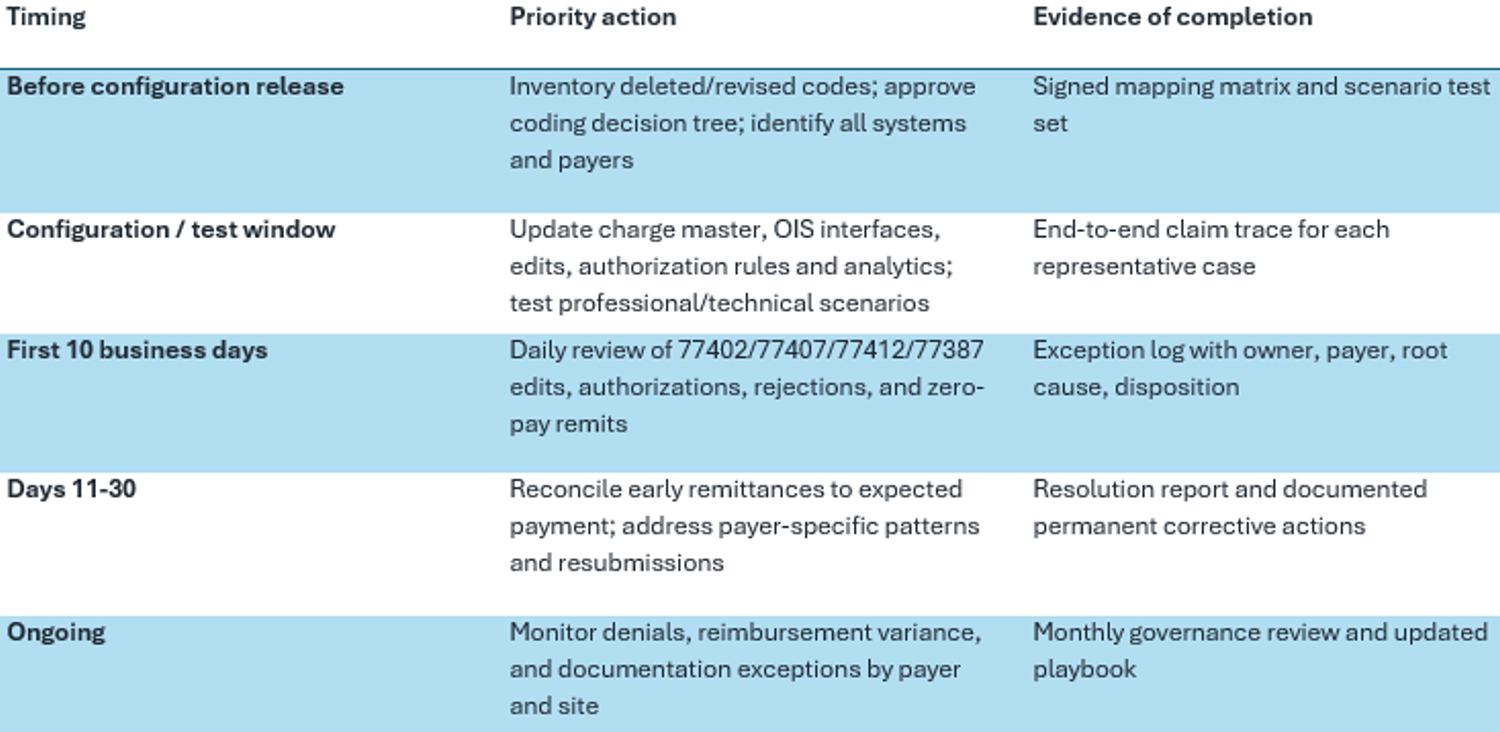
Finally, reprice expected reimbursement. A cleanly accepted claim can still pay incorrectly if contracted fee schedules, Medicare-based references, or payer edit logic lag the new coding structure. Contracting and revenue-cycle teams should set expected allowed amounts by payer, service, location, and effective date, then compare initial remittances against that model. Flag sudden zero-payment or unpriced codes immediately.
A practical 30-day validation and stabilization plan🔗
Use denial patterns as feedback on implementation🔗
ASTRO reported early payer interpretation issues for 77412, including misunderstanding multiple isocenters and requests for clearer documentation of active motion management. It also identified professional image-guidance claim denials involving 77387-26 and payer/place-of-service processing. These examples are reasons to instrument the transition, not evidence that every denial reflects an internal coding mistake. A specialized review should distinguish deficient documentation, inappropriate code selection, obsolete charge mapping, and payer edits needing escalation.
An experienced radiation oncology partner helps connect these moving parts. Medusind’s specialty-focused model combines radiation oncology expertise, ROCC-certified coding oversight, billing governance, and reimbursement follow-through. The test of successful implementation is not whether the new code list was installed; it is whether the full claim pathway is functioning correctly, treatment activity maps to defensible codes, and reimbursement variances are visible quickly enough to act.
Explore how specialized radiation oncology revenue cycle support can help operationalize coding change.
Sources: ASTRO, “Major Radiation Oncology Code Changes in 2026” (Winter 2026); ASTRO, “Treatment Delivery” and “IGRT” coding FAQs; ASTRO, “Early 2026 Prior Authorization denial trends” (Jan. 14, 2026); ASTRO, “ASTRO updates - New Treatment Delivery and Image Guidance Codes” (Feb. 26, 2026); CMS, Billing and Coding: Radiation Therapies A59350, revision history; UnitedHealthcare, “New simplified radiation therapy prior authorizations” (2026).