



- A/R & Denial Management
Radiation Oncology Denials: Causes & Prevention
In radiation oncology, a denial may appear after treatment is complete, but the reason frequently begins much earlier: an authorization that no longer fits the plan, documentation that does not establish the billed complexity, an outdated system mapping, or a payer edit that does not reflect the current code structure. Treating all of these as “billing denials” hides the problem—and encourages staff to fix claims one at a time rather than prevent the next one.
A high-performing denials program has two jobs. It must recover payment on individual claims, with timely appeals and follow-up. Just as importantly, it must use every material denial trend to improve the clinical-to-cash workflow. Both require radiation oncology-specific expertise because a course of care may involve simulation, planning, physics, image guidance, treatment delivery, and management across multiple systems.
Which denial types deserve the closest attention?🔗
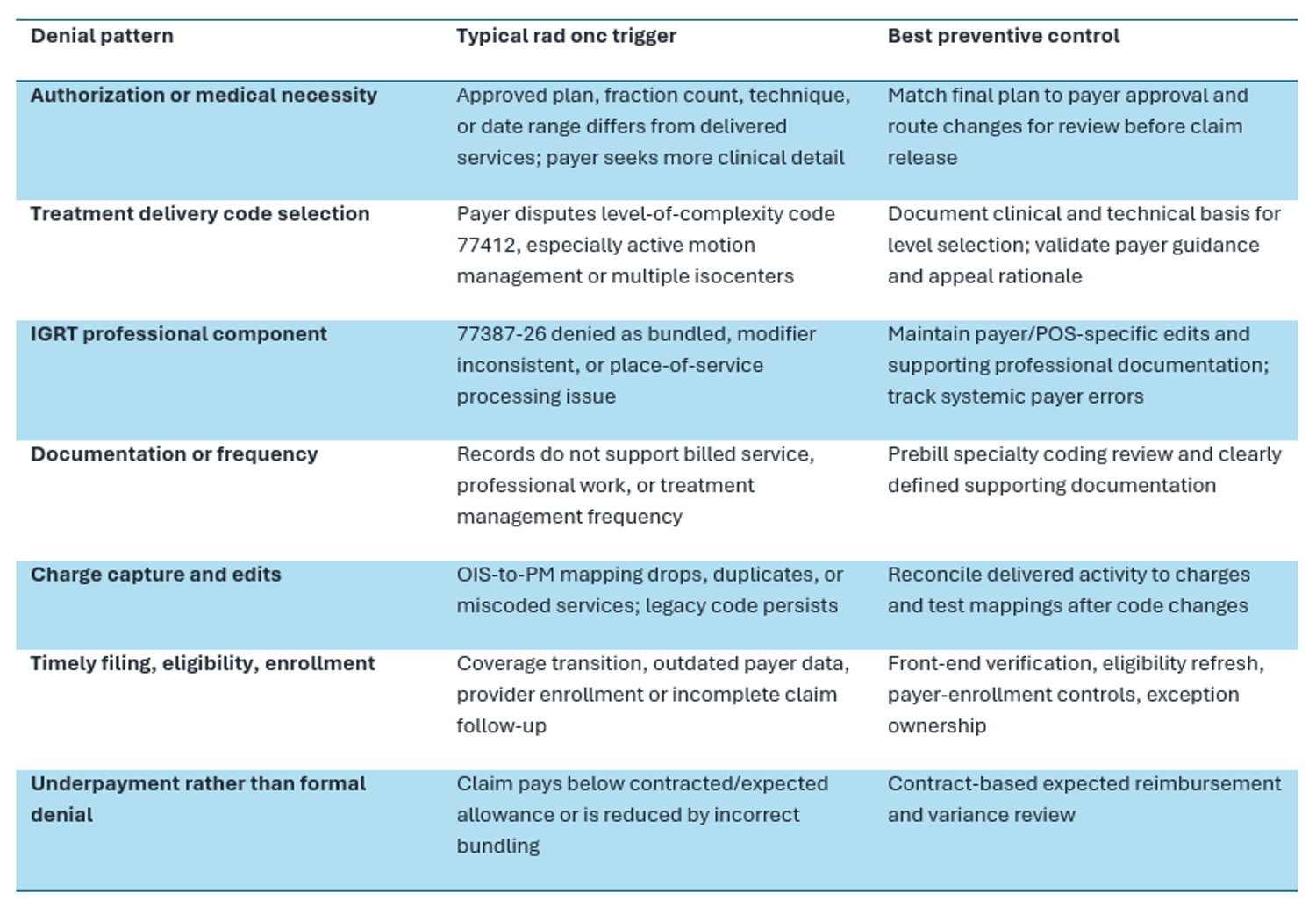
The 2026 code transition shows why payer-specific tracking matters🔗
ASTRO documented early 2026 denials associated with CPT 77412 and 77387-26. Some 77412 denials reflected restrictive payer interpretations of multiple isocenters or incomplete descriptions of active motion management. For 77387-26, disputes involved whether the image-guidance professional component was payable and how modifiers or place-of-service edits were applied. ASTRO subsequently reported payer and Medicare contractor corrections and advised practices to consult current individual-payer billing rules.
This distinction matters operationally. A clinically correct claim can fail because the payer has not updated its edit, while another claim fails because the treatment record does not demonstrate the qualifying service. Those cases should not go into the same generic denial bucket. One requires payer escalation and possibly broad reprocessing; the other may require documentation training or internal claim correction.
Best practice: investigate the source, not just the denial code🔗
Begin with a denial taxonomy that separates where the error arose: access and eligibility; authorization; clinical documentation; coding and charge generation; clearinghouse or payer adjudication; follow-up; and contract/payment variance. For each high-volume or high-dollar reason, sample several claims across patients and dates, then compare the treatment record, plan changes, approval, charge details, submitted codes/modifiers, and remittance explanation. The question is not only “how do we overturn this?” but “what allowed this to happen repeatedly?”
For example, if multiple claims for a treatment technique are rejected under the same code, reviewing all affected remits and payer correspondence may expose a payer-system issue. If denials cluster only around patients who underwent replanning, the issue may be a handoff between clinical and authorization teams. If zero-pay claims emerge after an OIS update, validate the system map before assigning the problem to billing staff.
Prevention requires controls before, during, and after treatment🔗
Before treatment, validate eligibility, referring and rendering provider enrollment as applicable, payer policy, approval details, and documentation sufficiency. At a change in care plan, establish a trigger for authorization and coding review. At charge capture, reconcile OIS activity to the billing record and check frequency, modifiers, and professional/technical relationships. After adjudication, compare allowed amounts to contract expectations and distinguish denial recovery from underpayment recovery. These controls work best when each exception has an owner and an escalation clock.
Do not let the denial queue become the only place where people discuss workflow failures. A brief weekly review between coding, authorization, billing, operations, and the clinical team can identify common patterns. Track preventable-denial rate, denial dollars by true root cause, overturn rate, payer resolution time, underpayment variance, and aged A/R. A month-over-month decline in repeated causes is a better sign of improvement than a large number of appeals completed.
The leadership opportunity: fewer repeats and better visibility🔗
Revenue leaders need to see the economics of denials, not only the count. An appeal that eventually pays still consumes staff time and delays cash. One denied high-value claim can matter more financially than several low-value edits, while a persistent small-dollar defect can erode collections at scale. Prioritize by recoverable value, time sensitivity, recurrence, and patient impact rather than first-in-first-out alone.
Medusind brings radiation oncology-specific workflows and ROCC-certified coding oversight to support defensible coding, structured follow-up, and insight into recurring reimbursement problems. Strong denial management is not simply more appeals. It is a repeatable method of connecting the payer response to the clinical and operational decision that produced the claim—and changing the process when the evidence points upstream.
See how a treatment-course revenue integrity review can help surface recurring denial drivers.
Sources: ASTRO, “Early 2026 Prior Authorization denial trends” (Jan. 14, 2026); ASTRO, “ASTRO updates - New Treatment Delivery and Image Guidance Codes” (Feb. 26, 2026); ASTRO, “Treatment Delivery” and “IGRT” coding FAQs; CMS Medicare Coverage Database, Billing and Coding: Radiation Therapies (A59350).