Clinical Pathology Modifier 26 Billing
This article explains how pathology groups can support Modifier 26 billing with proper documentation, eligible CPT codes, and clear professional interpretation requirements.
What is CPT Modifier 26, and When Do Pathology Services Require It?🔗
In clinical pathology, CPT Modifier 26 is used to denote the Professional Component (the physician's interpretation and formal report) when a diagnostic test is performed using equipment owned by a facility (such as a hospital) rather than the physician's private practice. This distinguishes it from the Technical Component (ТC), which covers the equipment, supplies, and technician salaries.
The vast majority of clinical pathology laboratory codes (CPT range 80047-87999) are paid under the Clinical Laboratory Fee Schedule (CLFS) as a 'global' flat rate with no structural split between professional and technical components. However, a specific subset of clinical pathology services requires distinct medical interpretation by a pathologist. These are recognized under the Medicare Physician Fee Schedule (MPFS) and split via Modifier 26.
- Technical Component (TC): Covers the actual laboratory machinery, reagents, supplies, and technician or laboratory scientist labor required to perform the assay. This is typically reported by the facility/hospital or the performing lab.
- Professional Component (Modifier 26): Represents the physician's work in reviewing the data, interpreting the findings, correlating results with patient clinical history, and issuing a medically useful, narrative diagnosis.
What Documentation Standards Must Pathology Reports Meet to Support Modifier 26 Claims?🔗
Medicare Part B contractors and commercial payers are contractually bound to reimburse claims utilizing Modifier 26 for designated clinical, provided they satisfy three baseline clinical criteria:
- Attending Provider Request: The interpretation must be explicitly requested by the patient's attending physician. For hospital inpatients and registered outpatients, standing laboratory diagnostic protocols or institutional standing orders approved by the medical staff are legally acceptable. For independent outpatients, an individual, patient-specific request must be documented.
- Separate Written Narrative Report: The professional component cannot be supported by an automated printout or a simple mathematical number. There must be a distinct, standalone narrative report or a clearly structured section within the laboratory chart labeled explicitly as 'Interpretation, 'Diagnosis, or 'Pathologist Consultation Report. This document must reside in the patient's medical record and be signed by the interpreting physician.
- Demonstrable Exercise of Medical Judgment: The report must clearly show that the physician applied specialized medical knowledge to the raw data. Simple phrases such as 'reviewed and agreed with the technical findings' or 'checked and confirmed' do not constitute medical judgment and will lead to immediate claim denial or post-payment audit.
Which CPT Codes Qualify for Pathology Billing With Modifier 26?🔗
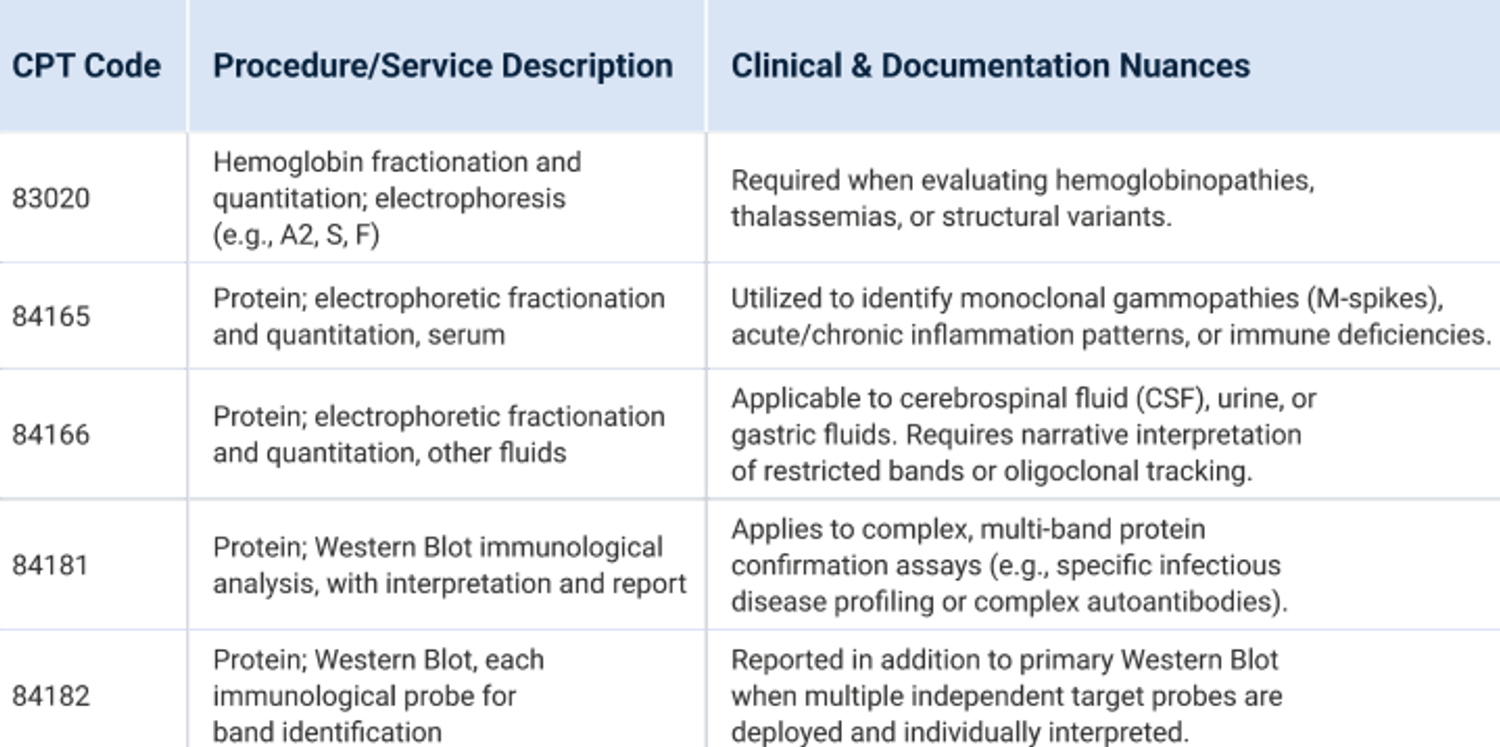
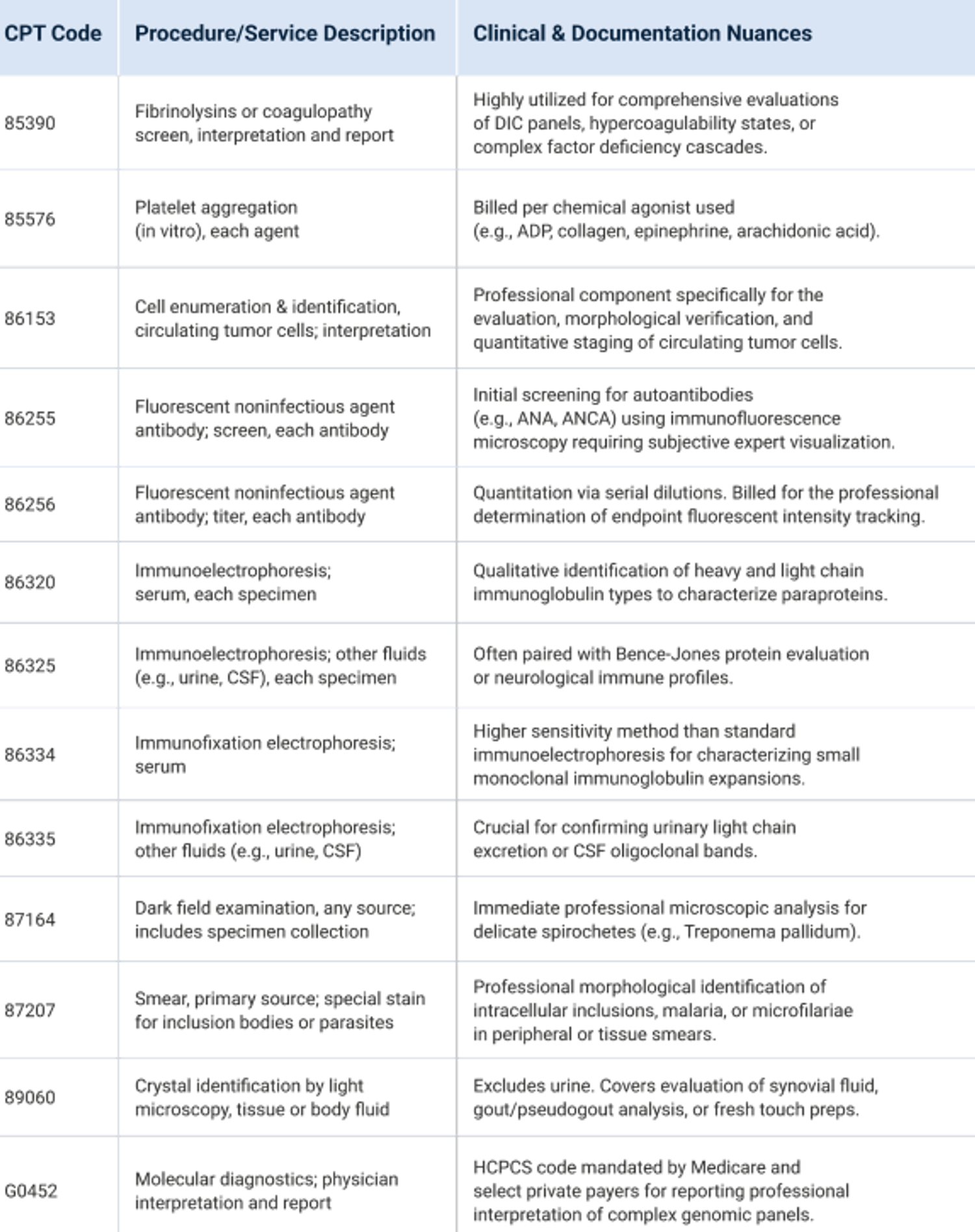
When billing exclusively for physician interpretation, append Modifier 26 to designated clinical pathology codes. Each code carríes specific clinical and documentation requirements.
How Should Pathology Groups Handle Methodology Shifts and Multi-Unit Billing Restrictions?🔗
A. Hemoglobin Fractionation Methodology Shift (83020 vs. 83021)
Modern clinical laboratories frequently shift from traditional gel electrophoresis to High-Performance Liquid Chromatography (HPLC) or Capillary Electrophoresis. HPLC is technically reported under CPT code 83021. However, CPT code 83021 does not possess a professional component split in the Medicare Physician Fee Schedule database.
B. Platelet Aggregation (85576) Multi-Unit
CPT 85576 is structured as 'per agent.' If a standard panel tests platelet reactivity against four independent agonists (e.g., ADP, Collagen, Epinephrine, Ristocetin), the billing is highly dependent on how the written report is structured:
- Multi-Unit Billing: If the pathologist provides separate, individual medical commentary or clinical synthesis for each individual agent (e.g., analyzing specific drop-offs or slopes distinct to each agonist), the professional component can be billed with multiple units: 85576-26 x 4 units.
- Single-Unit Billing Restriction: If the pathologist issues an aggregated, singular summary statement (e.g., 'Platelet aggregation profile is within normal clinical limits across all tested agents'), payers restrict reimbursement to a single unit: 85576-26 x 1 unit.
C. Crystal Identification Restrictions (89060)
This code is highly scrutinized. It applies strictly to body fluids (such as synovial fluid or pleural fluid) and fresh tissue touch-preps/squash-preps.
- It cannot be reported for routine crystal evaluations in standard urine samples.
- It cannot be used for examining standard processed, paraffin-embedded tissue blocks. Paraffin processing dissolves the vast majority of clinically significant crystals (e.g., monosodium urate), rendering formal paraffin evaluation medically invalid for this code.
What Separate Codes Should Be Used When Pathology Consultations Fall Outside Specific Interpretative CPT Codes?🔗
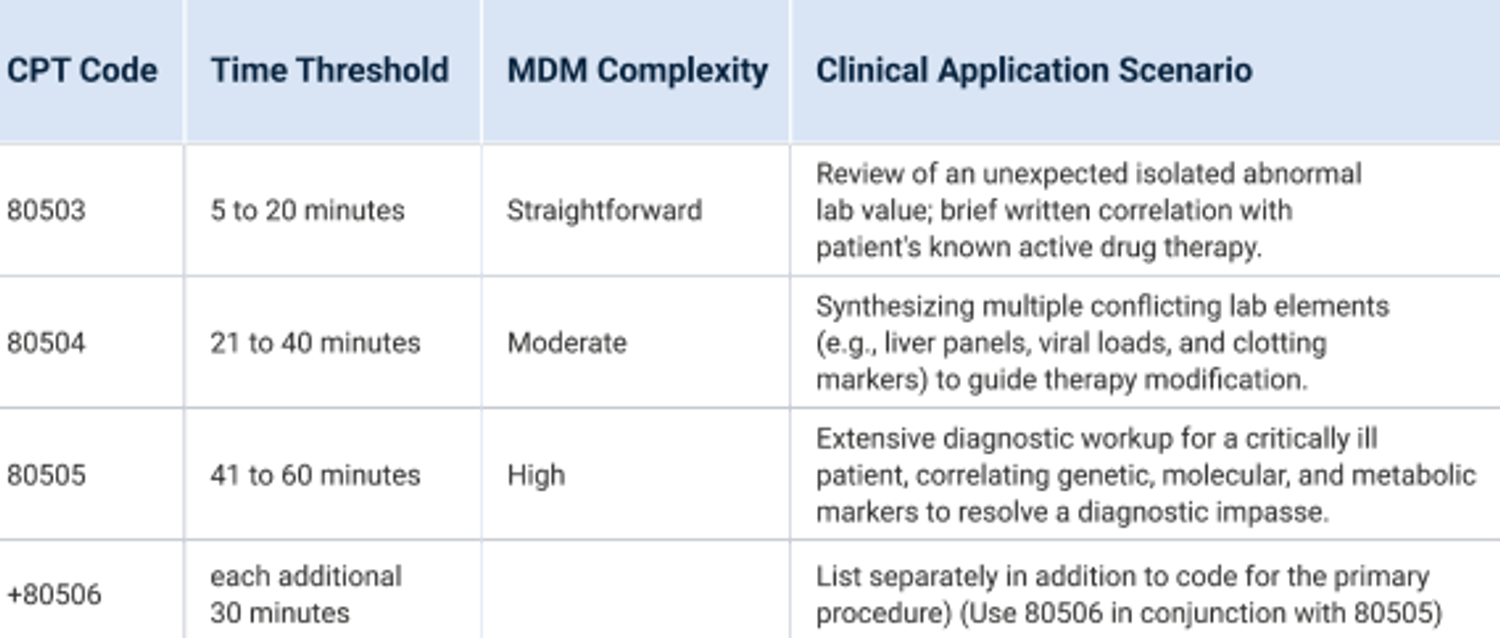
When an attending physician requests a comprehensive medical consultation regarding a complex clinical laboratory profile, and that service is not covered by a specific interpretative CPT code, providers must look to the dedicated Clinical Pathology Consultation codes.
Reformed to align with modern Evaluation and Management (E/M) frameworks, these codes are selected based on either total cumulative time spent on the date of the consultation or the level of Medical Decision Making (MDM).
Why Does CPT 85060 Not Require Modifier 26, and What Place-of-Service Restrictions Apply?🔗
CPT 85060 (Blood smear, peripheral, interpretation by physician with written report) is a unique entity within clinical pathology. This code is classified under the Medicare Physician Fee Schedule as a wholly professional service.
- No Modifier 26 Required: Because the code itself describes a purely professional physician service, appending Modifier 26 is redundant and can cause automated clearinghouse front-end rejection.
- The Medicare Outpatient Place-of-Service Restriction: Medicare will only reimburse CPT 85060 if the patient is a registered hospital inpatient (Place of Service 21) or a hospital outpatient (Place of Service 22). If a peripheral blood smear is interpreted for a Medicare beneficiary who is a private office clinic outpatient (Place of Service 11) or an independent commercial laboratory client, the claim is unallowable under Part B.
Which Blood Banking Procedures Require Direct Pathologist Oversight for Separate Billing?🔗
Specialized immunohematology services where direct medical selection, safety verification, cross matching, or adverse reaction evaluations require dedicated pathologist overviews.

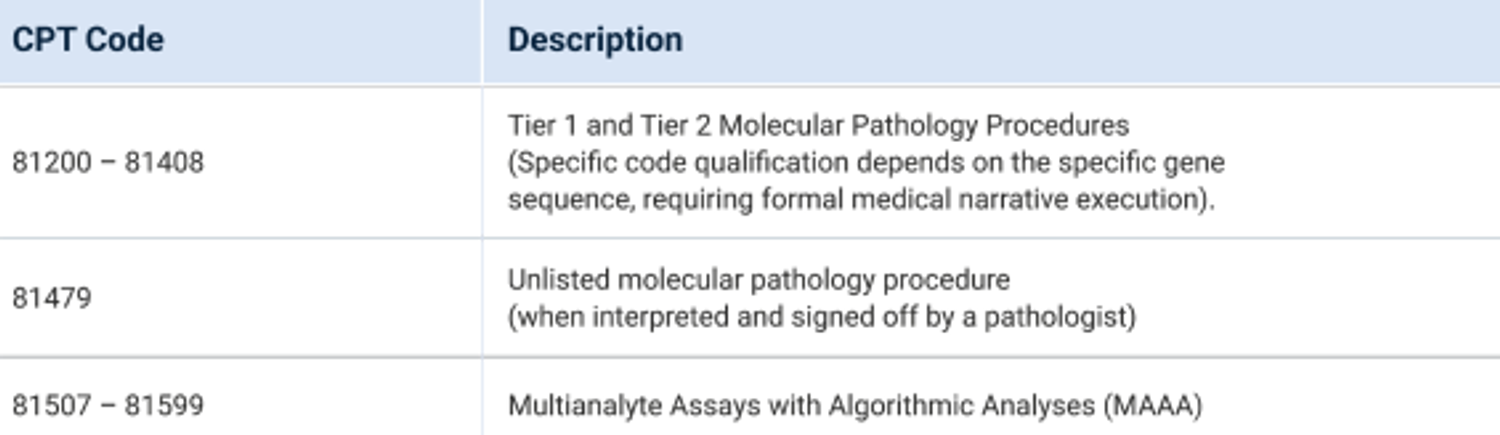
How Do Pathology Groups Capture Professional Component Revenue From Molecular and Genetic Testing Interpretation?🔗
Many complex molecular diagnostics allow a distinct professional component when a pathologist must structurally interpret raw sequence data, structural variants, or multi-gene panels to produce a medical narrative report.